
Leadership tools for the real world
Leadership tools for the real world
Ethics is at the heart of classroom instruction at Quinlan and its legacy
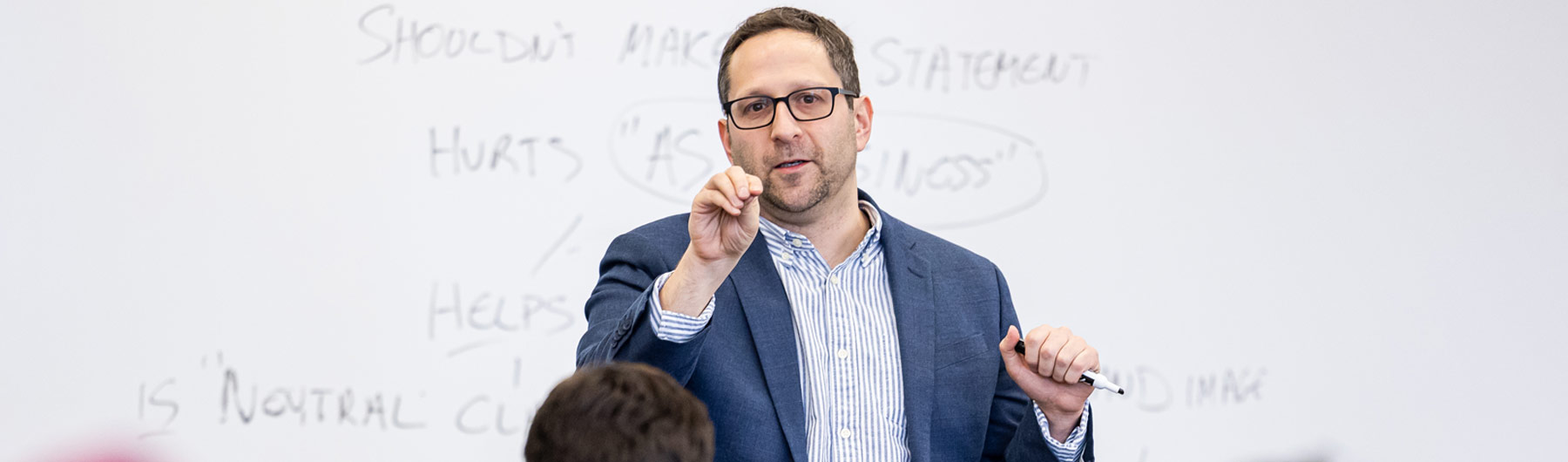
“The first principle is that you must not fool yourself,” said Richard Feynman, the Nobel-prize winning physicist, “and you are the easiest person to fool.” It’s a principle espoused by Abraham Singer, an associate professor at Loyola University Chicago’s Quinlan School of Business, in teaching ethics in Quinlan’s Executive MBA program.
Ethics is at the heart of business instruction, and for the students in Singer’s EMBA ethics course, the questions and issues that ethics raise are pragmatic—and nuanced and thorny. This is because there is generally no perfect solution to ethical dilemmas, which people always face as imperfect and biased decision-makers.
“A lot of unethical activity takes place in the business world that isn’t due to ignorance of what ethics or morality demands, or because someone is particularly evil or antisocial. It’s because people find ways to rationalize their behavior to themselves and others,” Singer said. “This course is built around identifying rationalizations in the business world."
In such cases, Singer discusses ways to resolve competing obligations executives may face—fiduciary, to shareholders, and to the community for example—and teases out the grounds of these obligations to help executives resolve conundrums. The goal is to identify how we can then put those moral convictions into practice. “I put a big emphasis on social and organizational environments,” Singer said. Embedding strong principles across the organization can act as a bulwark against ethical lapses.
“Ideally, you want to build the sort of culture that keeps ethical rationalizations from being viable.” Abraham Singer, associate professor
Where brilliance meets purpose

Research Collaboration
Elevating behavioral research
Cutting-edge business research on how people think, feel, and behave has a home at Assistant Professor Brittney Bauer’s Behavioral Lab.
Read about a hands-on research lab
Global Perspective
Transforming the world through marketing
Professor Clifford Shultz’s course taking graduate students to Southeast Asia provides the students a capstone like no other.
Read about a transformative course
Innovative Research
Breaking ground with biometrics
Associate Professor Dinko Bačić’s UX and Biometrics Lab is at the forefront of bringing professional research tools to business students.
Read about biometrics at QuinlanReal-world questions without easy answers
For Singer, it is crucial to give present and future business leaders who take his class the chance to think about ethics in tangible ways.
“The idea is to think about ethics in the wild, rather than as a merely abstract concept in the classroom,” Singer said. “If students apply the ideas to a specific business case, it makes it easier for them to apply the thinking to issues they may face in the workplace.”
Singer often begins with a commitment an executive may have, such as a commitment to profit or a social purpose, and places that intention against a second factor that they need to consider. “My goal isn’t to clarify things, but to confuse you at a higher level. There’s a practical virtue in examining things that upset what you think is settled. It leads to better thinking and problem-solving.”
Singer’s core mission is to impart deep critical thinking skills in his students, to prepare them for what can’t be anticipated.
“My job is—instead of giving a rule book on ethics—to arm my students with ideas and concepts that allow them to understand the social world they find themselves in and figure out how to act when confronted with difficult dilemmas.” Abraham Singer, associate professor
Legacy of ethics
The Quinlan School of Business’s commitment to business ethics dates to the 1960s, when Father Raymond Baumhart, S.J., who later became Loyola University Chicago’s longest-serving president, taught a course on the topic, helping spark an entire field of study.
Business ethics combined Baumhart’s interests in moral theology and business. He regularly hosted Chicago business leaders to speak with his class about ethical issues they had faced. His passion embedded a commitment to business ethics in the school’s DNA.


“Having ethics woven throughout our curriculum speaks to the fundamental values of this school and the University. At Quinlan, we are empowering tomorrow’s difference makers with the tools to do business in a way that supports people and communities and is ethical.” Michael Behnam, Dean of the Quinlan School of Business
Ethics is embedded in the heart of the business curriculum at Quinlan. It is a required course for both undergraduate and graduate students and an important part of the Baumhart Scholars MBA program, which is Quinlan’s social impact MBA.
“I imagine that at many other business schools, a person who teaches business ethics feels a little like an outcast who may be there just for box checking. That’s not how I feel at Quinlan. Business ethics is a central part of the business education here,” Singer said. “The school helped to found the philosophical study of business ethics, and I'm proud and quite humbled to be a part of that today.”
Preparing for power
For Singer, business ethics goes beyond corporate social responsibility (CSR) or environmental, social, and governance (ESG) reports. It’s about wielding power carefully and responsibly. He encourages students to think of holding a leadership position in a business as occupying a type of social office, a perch of power.
“You’re not entitled to use that position of power for your own personal ends – or your own preferred moral ideals,” he says. “It's less about a businessperson's personal beliefs or commitments, and more about the broader obligations that derive from society's shared commitment to democracy and justice.”
Singer says one of the most important things that a good leader does is to establish rules and policies that enable things to work well. “People often emphasize the ‘leader’ in leadership, but I think we should emphasize the ‘ship’ that is being built,” he said. “I think what’s most important is building the type of structures in your company that will allow you to behave ethically in the face of perverse incentives.”
Real-world questions without easy answers
For Singer, it is crucial to give present and future business leaders who take his class the chance to think about ethics in tangible ways.
“The idea is to think about ethics in the wild, rather than as a merely abstract concept in the classroom,” Singer said. “If students apply the ideas to a specific business case, it makes it easier for them to apply the thinking to issues they may face in the workplace.”
Singer often begins with a commitment an executive may have, such as a commitment to profit or a social purpose, and places that intention against a second factor that they need to consider. “My goal isn’t to clarify things, but to confuse you at a higher level. There’s a practical virtue in examining things that upset what you think is settled. It leads to better thinking and problem-solving.”
Singer’s core mission is to impart deep critical thinking skills in his students, to prepare them for what can’t be anticipated.
Legacy of ethics
The Quinlan School of Business’s commitment to business ethics dates to the 1960s, when Father Raymond Baumhart, S.J., who later became Loyola University Chicago’s longest-serving president, taught a course on the topic, helping spark an entire field of study.
Business ethics combined Baumhart’s interests in moral theology and business. He regularly hosted Chicago business leaders to speak with his class about ethical issues they had faced. His passion embedded a commitment to business ethics in the school’s DNA.
Students wrestle with ethical dilemmas in Professor Singer's classes—and throughout the Quinlan School of Business curriculum.
Ethics is embedded in the heart of the business curriculum at Quinlan. It is a required course for both undergraduate and graduate students and an important part of the Baumhart Scholars MBA program, which is Quinlan’s social impact MBA.
“I imagine that at many other business schools, a person who teaches business ethics feels a little like an outcast who may be there just for box checking. That’s not how I feel at Quinlan. Business ethics is a central part of the business education here,” Singer said. “The school helped to found the philosophical study of business ethics, and I'm proud and quite humbled to be a part of that today.”
Preparing for power
For Singer, business ethics goes beyond corporate social responsibility (CSR) or environmental, social, and governance (ESG) reports. It’s about wielding power carefully and responsibly. He encourages students to think of holding a leadership position in a business as occupying a type of social office, a perch of power.
“You’re not entitled to use that position of power for your own personal ends – or your own preferred moral ideals,” he says. “It's less about a businessperson's personal beliefs or commitments, and more about the broader obligations that derive from society's shared commitment to democracy and justice.”
Singer says one of the most important things that a good leader does is to establish rules and policies that enable things to work well. “People often emphasize the ‘leader’ in leadership, but I think we should emphasize the ‘ship’ that is being built,” he said. “I think what’s most important is building the type of structures in your company that will allow you to behave ethically in the face of perverse incentives.”